Posts

Showing posts with the label Army of Montrose

Donald Farquharson of Monaltrie’s Highland Regiment of Foot

Image
Technically the third of two promised new Scottish units. If sci-fi writers can have four part trilogies, I can have three of two. If you think that is slightly confusing, the rest of this post continues in the same vein... Donald Oig Farquharson of Monaltrie was called ‘the pride of Braemar'; he spent six months at court and clearly made an impression, as Charles would always call him "my man". Whilst visiting Edinburgh King Charles was informed of Donald being threatened in a fray by some Covenanters, the King angrily exclaimed, “Who dares be so bold as to touch my man, Donald Farquharson?”  This is how they originally appeared on KeepYourPowderDry in December 2020. Donald would be slain by a pistol-shot in street fighting in Aberdeen on 16th March 1645. His death was much lamented by the Marquis of Montrose, who had his body buried with military honours in Drum's Aisle of St. Nicholas Church, Aberdeen. A Victorian plaque marks the supposed spot. Raised  in 1639 t...

A Furtle in the Spares Box

Image
Having just had a reorganisation of my storage boxes, and realising that my two Scottish armies now had space... I resorted to going through my spares boxes in order to work out what purchases would be required to fill the newly found vacant space. A Freikorps Covenanter officer Might as well paint them up whilst I await the postie bearing packets of lead and freshly layered MDF. Inspired by my attention becoming very Scottish-centric over the last year or so, I have decided upon some more Covenanters. Command figures found for a new regiment of horse, and company of firelocks. Great, that saves a tenner. But what are these, lurking in the Celtic spares box? Two pack horses (for frame guns) and horse holders and a civilian woman.  Montrose's artillery park gets a 200% expansion, with just a pack of Scots artillery crew and a pair of custom casualty markers from Warbases needing to be purchased. Only problem was that the 'woman' is actually a monk. Something I only realised ...

So You Want To Know About Scots Armies?

Image
As the Scots fought on both sides, and regularly changed allegiance it makes sense to just write one Scottish reading list. Regular readers (hello all 12 of you) may have noticed a bit of a shift to matters north of the wall. You'd be correct, and can expect quite a bit of Scottish content over the next few months. The 'regularly changed allegiance' bit of that sentence seems rather flippant, but in reality the Scots were looking after number 1. They wanted to protect the rights of the Presbyterian Church in Scotland and would support whomsoever they thought would guarantee those rights. We mustn't overlook those Scottish lords who appear to have harnessed the chaos of the wars to settle old scores, consolidate and extend their lands, and generally feather their own nests. Our starting point has to be Professor Furgol's "A Regimental History of the Covenanting Armies 1639-1651" (John Donald Publishers) .  Long out of print, copies do surface from time to t...

Celtic Command

Image
The current rash of 'new senior officers' continue. When will it stop? Pretty soon I'd imagine (the box of shiny things is now empty). So here is a senior officer apiece for the The Solemn League, Montrose, and The Catholic Confederacy. These are PP figures from their 'personalities section, who have been repurposed. As with previous figures from the PP personality section, major surgery was required to remove the vast majority of their bases. First up is  John Lindsay, Earl of Crawford-Lindsay , who is the Hasselrigg figure from the range in case you are wondering. John is resplendent in full cuirassier armour. John, born around 1598, was the eldest son of Robert, 9th Lord Lindsay,  and Lady Christian Hamilton. On his father's death in1616, he became the 10th Lord Lindsay of the Byres. 1633, he was elevated to  Earl of Lindsay. He also inherited the Earldom of Crawford following his cousin, Ludoivic, forfeiting the title in November 1652. He was appointed Treasurer...

Flags and Colours Part 2b: Evidence (Irish Confederacy)

Image
Irish flags... a conundrum. I knew that a number of flags were recorded, but without any reference to allocation to particular regiments. I also remember reading one internet reference that stated that each flag had two different sides. But I'd never come across the source material supporting this claim, or even a secondary source that described/illustrated the flags thus. Until now... But first a little bit of flag nomenclature (which if you want to impress people you can call vexillology). If you cut a flag down its middle and spread it out on a table, positioning the pole sleeve in the middle, the left hand side is the 'reverse' and the right hand side is the front of the flag, or 'obverse'. Regular readers, hello all twenty of you, will have realised that clothing issue 'floats my boat', I'm not really very good on flags. Most of my flag knowledge is gleaned from secondary sources, and the handful of more readily accessible primary sources.  The sour...

Celtic Baggage Redux

Image
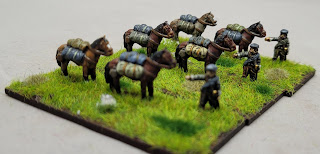
 Jings and crivens! Even more baggage? I'm afraid so. The last part of my Montrose/Solemn League/Irish Confederate baggage extension is complete. Erm... actually it isn't. Now that I have discovered that I can't actually see the figures properly when painting, and that 2.0 readers from the cheapy shop help enormously, I will be tidying these up. The strap work on those bags is shocking! The Irish Confederates have two pack horse trains. These are Chariot figures from Magister Militum. Magister Militum are in the process of shutting up shop, and these figures are now unavailable; MM are finding new homes for their ranges, to date I haven't heard any news about anyone talking the Chariot range on yet. Originally the pony handlers had Scots bonnets, they have been replaced with Peter Pig Irish heads. The Confederates also have two, two-wheeled carts added to their baggage train. Both from Museum Miniatures' extensive baggage range. Each cart has a Peter Pig dragoon ho...

Scottish Baggage

Image
Reading books doesn't half cause problems, and I don't just mean finding shelf space for yet another book. Glenn Price (Soldiers and Civilians, Transports and Provisions) argues that a significant hindrance to the Scots armies manoeuvring in Scotland, was the quality of the roads - their baggage and supplies had to be carried on pack horses rather than carts in the main part, roads were often impassable to carts. Which ultimately means a bit of a rethink on my Scottish and Irish baggage trains. My Covenanter army has a couple of pack horses (one hander to one horse), and a four wheel heavy cart. Fine for the lowlands and their excursions south of Hadrian's Wall, but no good for campaigning in Scotland. Throw into the mix Magister Militum shutting up shop, I decided to pick up all the remaining packs of pack horses. I also purchased some two wheel carts from Museum Miniatures. With a little reorganisation, this gives me a slightly more appropriate baggage train. Each of the ...

Captain John Mortimer’s Troop of Dragoons

Image
Whilst technically a Confederate troop of dragoons, Mortimer's did their soldiering in Scotland as part of the Irish Brigade. But as I apply a fantasy football league style approach to the composition of my armies, I'm having them! There once was a troop o' Irish dragoons Cam marching doon through Fyvie-o And the captain's fa'en in love wi' a very bonnie lass And her name it was ca'd pretty Peggy-o The Bonnie Lass o' Fyvie Raised in March 1645 from  Colonel Manus O’Cahan’s Regiment of Foot  they weren't exactly dragoons as we know it. They were musketeers put on horseback. Captain John having served as an officer in O'Cahan's. As with so many Irish units from the Wars, we know very little about them. Mortimer is believed to have been a Scot, rather than an Irishman. They fought at Aberdeen, Kilsyth, and Philiphaugh. At Philiphaugh it appears that they fought as a troop of horse; Mortimer is thought to have been captured following the battle a...

Warlord Pike and Shotte Epic Battles: the Scottish sprue

Image
Another 'freebie'* with  this month's edition of Wargames Illustrated, so I thought it was my duty to pick up a copy and  review them. Hopefully, my latest review of an Epic product won't generate the hate mail that my original posts did. Warlord's Epic Pike and Shotte is, let's be honest, a bit of a Marmite thing (you either love it, or hate it). I probably fall between the two camps: a bit disappointed with the figures, specifically the cavalry sprue; yet hopeful that other manufacturers will produce stuff to support the range; and, of course I am all for a new range of 'true 15mm'** figures that covers my favourite period (particularly from a company with the 'reach' of Warlord Games). This is, by necessity, a one sprue fits all solution, so combines, foot, artillery, dragoons and horse. Let's look at the sprue in detail. The Epic look is not for everyone, but the foot strips are crisply detailed, no strange hands on pikes this time (maybe...