Posts

Showing posts with the label Trained Bands

The City of London Yellow Auxiliary Regiment of Foot
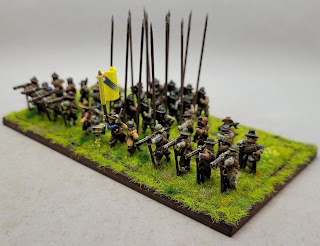
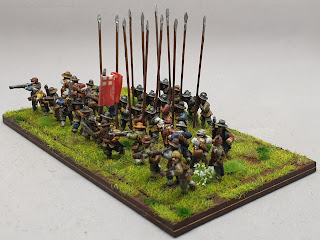
Image
My final* unit of figures to paint. The 'to do' pile is empty.  So here they are the City of London Yellow Auxiliary Regiment of Foot of the London Trained Bands. A strange choice I hear you say... I selected them purely because their flag is a bit different to any of my other regiments. That really is the reason I have represented them. The City of London Yellow Auxiliary Regiment of Foot of the London Trained Bands (a bit of a mouthful, so from now on 'City Yellow Auxiliaries') were raised on the 12th of April 1643 during the reorganisation and expansion of the London Trained Bands (henceforth LTB) in the Farringdon Within, Castle Baynard, and Aldersgate areas of the City (in other words the same areas as the Yellow Regiment). If you are new to the Trained Bands, and the Auxiliaries in particular see my earlier posts: The Trained Bands The Auxiliary Regiments Their history is somewhat confusing: much seems to stem from which auxiliary regiment is which. It was the co...

Sashes*

Image
Hold your horses partner, as the denizens of the former colonies might say. Sashes? If you mean the fancy silk thing worn by officers in C17th portraiture then you are in the right place, but they weren't called sashes. Thems were called scarves. Now we've got correct nomenclature out of the way we can move on. Colonel Nathaniel Fiennes 1641, by Michiel Janszoon van Mierevelt You will often see portraits of Charles, his sons, and his nephews wearing blue  sashes  scarves. Only these aren't sashes, or even scarves. These are ribands, signifying that they are members of The Order of the Garter. The Order underwent a bit of a renaissance during Charles' reign, and also his eldest son's, no doubt as a means for raising revenue. Charles wearing the Order of the Garter riband, Sir Edward Walker wearing a rose scarf and a riband signifying that he is Garter King of Arms  But first let's start with who wore scarves and how they wore them.   One only has to look at portr...

The Auxiliary Regiments of the London Trained Bands: Blue Coats?

Image
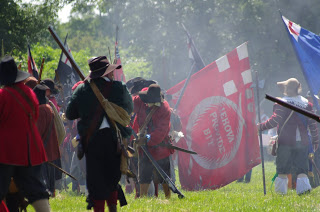
Regular readers (hello both of you) will know that I have a bit of a bee in my bonnet about Wargamer Facts ™ . Here's the latest Wargamer Fact ™ to go under the KeepYourPowderDry investigative microscope. By default this post has become part of my coat colours series. You can find the rest of the posts here: Introduction   Part 1  Parliamentarian coat colours Part 2  Royalist coat colours Part 3  Scots coat colours Part 3B  Montrose and the Irish Brigade Part 4  Dragoons, Horse and the New Model Army coat colours The Trained Bands Scarves   Having seen the phrase "the London Auxiliaries may have received blue coats" many times I decided to look into the source of this information. Just as another  wargamer fact™ asserts that the London Trained Band wore red coats*, this "blue coats" fact™  would   seem to be on equally shaky ground. 1939 Player's Cigarettes card: Trained Bands of London But first, who were the London Trained Bands ...

The White Regiment of Foot of The London Trained Bands

Image
 After what seems like a very long break from painting I return to my last, currently planned*, Regiment of Foot. So without further ado, let me introduce the White Regiment of Foot of the London Trained Bands. The second most senior regiment in the LTB, they were recruited from north of the City: Cornhill, Lombard Street, Fenchurch Street, and upper Gracechurch Street. An area of London populated by goldsmiths, financiers and wealthy merchants.  Their colonel, Alderman Isaac Penington had been elected as a sheriff of London in 1638, and would be appointed Lord Mayor when Parliament removed the Royalist Sir Richard Gurney from office in August 1642. In 1649 Penington would be made a commissioner of the High Court of Justice and attended the King's trial: he did not sign Charles's death warrant. He would surrender at the Restoration, hoping for leniency as he hadn't been a signatory of the death warrant. His lands were confiscated and he would spend the rest of h...

Blue Regiment of Foot of the London Trained Bands

Image
And so, dear readers (hello both of you), our attention returns to the London Trained Bands; rather than regale you with discussion about their uniforms (or lack of them) I will, instead, direct you  here . The Blue Regiment was the fourth in seniority within the London Trained Bands system. It was recruited from the wards of Bridge, Walbrook, Bread Street, Candlewick, Dowgate, Vintry, Cheap and Queenhithe. Although the London Trained Bands were used primarily to defend London, regiments marched out from the City with the Earl of Essex’s army on a number of occasions.   The Blue Regiment were at Turnham Green; went to the relief of Gloucester; fought at First Newbury; took part in a skirmishes at Aldermaston and Padworth; and returned to Newbury for the Second Battle. After Second Newbury they returned to London (the other LTB regiments returned to London not long after) as the New Model Army became Parliament's field army of choice. After 1645 nothing really of note happened ...

Kent Trained Bands

Image
Kent was a deeply divided county in the Civil War; although nominally under Parliamentary control, there were Royalist risings in Tonbridge and Sevenoaks in 1643, Canterbury in 1647 and a major uprising in 1648, culminating in the Battle of Maidstone. The Trained Bands however remained firmly in Parliamentary control, even in 1648, and formed part of the Southern Association under Sir William Waller. The Bands were organised by "lathes" or areas, a system unique to Kent believed to date to the Kingdom of the Kentish (which existed until the 9th Century). There were five Lathes: Sutton at Hone – adjoining London, including Blackheath, Bromley, Dartford and Westerham Aylesford – from Chatham and Rochester in the north  to Tonbridge in the south, with the county town, Maidstone. Scraye – a more rural area, though including Ashford and Faversham. St Augustines – Canterbury, and the north Kent ports of Dover, Deal and Sandwich Shepway – the south Kent ...

Auxiliary Regiment of the City of Bristol Trained Band

Image
Why has this regiment got a 'Parliamentarian' tag and a 'Royalist' tag I hear you wonder? Originally raised by the good citizens of Brizzle, in 1638 they  consisted of 300 men armed with 210 muskets and 90 corslets; many of these men would venture north to fight in the Bishops Wars the following year. As the country edged closer and closer to Civil War, Bristol was trying to remain resolutely neutral.  When Essex marched on the city the city governance accepted the inevitable and allowed Essex's men to enter Bristol. So the Bristol Trained Bands became 'parliamentarian'. At the outbreak of war the Trained Band was commanded by Colonel Andres Charleton. When Bristol fell to the Royalists the Regiment changed allegiance.  The Trained Band would pretty much remain Bristol's garrison regiment regardless of which faction was in control.   By 1645 there were two regiments of the, now Royalist, Trained Band in the city: they were commanded by Co...

Tower Hamlet's Trained Band

Image
Welcome to my Tower Hamlet's Trained Band. A unit that has had more incarnations than a Tina Turner tribute act has outfit changes. They appeared on this blog in one of the first entries with a green flag; once my knowledge of the London Trained Bands grew I realised that the flag was incorrect (I'd trusted a list on the internetz!) so the flag was replaced with the 'correct' one. Add some more LTB knowledge and I realised that they really probably shouldn't be wearing red coats either  (I'd trusted a list on the internetz - I sense a pattern emerging). So rather than repainting them, my original Tower Hamlet's Trained Band were reborn as Colonel John Birch's Regiment of Foot. So I present to you the Tower Hamlet's Trained Band mkII. Depicted wearing civilian clothes, and a hefty smattering of trained band buff, you'll be pleased to hear that they are carrying the correct flag for 1643-1647. Their flag is rather odd in so far that it doesn...

Coat Colours Part 5: The Trained Bands

Image
As I was about to post about the Tower Hamlet's Regiment of the London Trained Bands, and about to go down my usual ranty rabbit hole about coat colours I thought it better to write a general post about Trained Bands. This got out of hand a little and became the coat colours series, without even touching upon the Trained Bands.  When I first started my ECW project I took at face value lots of information from what I believed to be 'trusted' sources: it only took a little  cursory reading to quickly realise that many of these 'trusted' sources replicate the same errors. Which is why my original Tower Hamlet's Regiment wore red coats and carried the 'wrong' flag. They were quickly given the correct flag, but the red coat issue was slowly nagging me. They have since been rechristened John Birch's, and the Tower Hamlets LTB has been raised anew. This post is a bit more than  Coat Colours Part 5 Introduction   Part 1  Parliamentarian coat colours Part ...