Posts

Even More Parliamentarian Commanders
Image
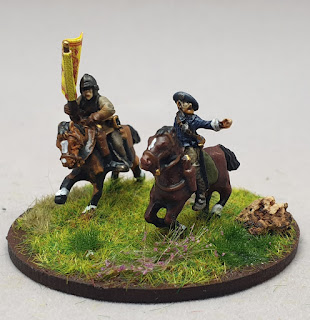
There were more Royalist commanders, so only a matter of time before there were more Parliamentarian command figures. First up Sir William Waller , an unadulterated figure, Sir William has a spare regiment of foot flag  on his base. Pure bunkum, as a found/captured ensign would be paraded rather than just left on the floor. Normally Maverick flags need sealing with a PVA/water mix but I didn't think I'd be able to get the close folds that I wanted. Trimmed very carefully with a new X-Acto blade I cut the flag so that I had the side I wanted and just enough to wrap around the flagstaff (a spare pike I had lying around), I superglued the flag in position, and once dry I washed the flag with a 75/25 mix of PVA and water, left it to dry for a few minutes then made the folds. Frequent adjustment was required whilst it dried, then any loose strands of fabric were trimmed once it was thoroughly dry. Waller's history is entwinned with that of his good friend, and opponent Sir Ralph...

Sir Arthur Aston’s Regiment of Horse

Image
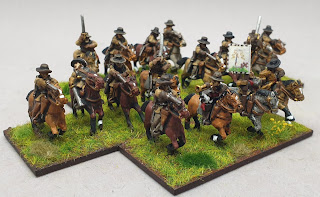
Regular readers (hello both of you) will be familiar with Sir Arthur  and know all about how he earned a spot in the Horrible Histories 'stupid deaths' hall of fame. His Regiment of Horse were raised in Oxfordshire and the North in 1642 after the Battle of Edgehill; they took part initially garrisoned Reading; they took part in a skirmish at Henley-on-Thames; the siege of Reading; a raid on West Wycombe; a skirmish at Padbury; they stormed Bristol; the siege of Gloucester; a skirmish at Aldbourne Chase; First Newbury; before they garrisoned Oxford. In September 1644 field command of the Regiment passed to Lieutenant Colonel George Boncle who led the men at the relief of Basing House; the storm of Leicester; and Naseby. George was captured at Naseby and his brother Sebastian Boncle took over command. The Regiment continued but their service is not clear; possibly remaining as part of the Oxford garrison. This is the last of my planned Royalist Regiments of Horse, giving a gran...

Sir Nicholas Crispe’s Regiment of Horse

Image
 A regiment of horse from the King's Oxford Army, that took an absolute hammering at Cirencester in September 1643: Cirencester had been taken by Essex in 1642, before Rupert recaptured the town in February 1643. Essex would again retake the town for Parliament in September 1643. Crispe's Regiment lost a number of cornets with white fields and black and white fringes at Cirencester; they are recorded in a muster in April 1644 as being four Troops but only having one cornet (in theory colours could not be flown by a troop or company that had lost their colours until they had captured a colour from the enemy). I've represented them carrying the cornet of Sgt Major Christopher Wormsley's Troop. Crispe was the son of a London Alderman, and at the outbreak of war he was an important Royalist agent in London, before he fled the capital to Oxford when an intercepted letter revealed that £3700 was owed to him ‘for secrett service done for his Majestie'. Commissioned to rais...

Lieutenant General Thomas Hammond's Regiment of Firelocks

Image
This Lieutenant General Thomas Hammond must not be confused with Lieutenant General George Hammond, commander of Stargate Command. Hammond's firelocks were the artillery guard of the Eastern Association, not a galaxy traveling special forces unit that was part of Stargate Command. Believed to have been raised at the same time as the artillery train of the Eastern Association, they were most likely present wherever the Eastern Association fought: more specifically they were possibly present at Lincoln, and were certainly at the Siege of York and Marston Moor before continuing the fight at Second Newbury. In 1645 they joined the New Model Army as the Artillery Guard of Firelocks. In their new guise they fought at Oxford, Naseby, Leicester and Bristol. They are described as wearing tawny coloured coats pre NMA, then tawny orange coloured coats lined with white when they were the firelock guard of the NMA. Hammond was paid for two colours in April 1645, but we don't know what the...

Prince Maurice's Regiment of Horse

Image
 Another stalwart regiment of King's 'cavaliers'. An extensive roll call of battles bookending the First Civil War: Powick Bridge; Edgehill; the storm of Cirencester; taking of Evesham; skirmish at Little Dean; skirmish at Upton Bridge; Ripple Field; Caversham Bridge;  skirmish at Chewton Mendip; skirmish at Glastonbury and Somerton; skirmish at Bradford on Avon; Lansdown; Roundway Down; storm of Bristol; siege of Barnstaple; siege of Exeter; First Newbury; siege of Plymouth; Cheriton; Tipton Green; Cropredy Bridge; Lostwithiel; Second Newbury; the relief of Donnington; the relief of Chester; the relief of Beeston Castle; stormed  Evesham; storm of Leicester; Naseby; storm of Huntingdon; Rowton Heath; skirmish at Tutbury; finishing the First Civil War at Stow on the Wold. Pretty much only Marston Moor missing from the First Civil War Greatest Hits album... Maurice was of course Rupert's younger brother; aged sixteen, Maurice's military career began in the Prince of ...

Sir Allen Apsley's Regiment of Foot

Image
The very last of my Royalist Regiments of Foot - that's a total of seventeen pike and shot, and three commanded shot (650 men in case you were wondering). But we've heard that before, so we'll settle on 'last' for the moment . Although... I have just learned that Sir Beville Grenville's Regiment of Foot had blue and white painted pikes and musket rests...  Allen, Alan, or Alen? Apseley or Apsely? All used, so take your pick: I'm going with Allen Apsley (as that is what is carved upon his tomb in the south ambulatory of Westminster Abbey). Raised in 1643 in Devon, the Regiment served in the West Country and with the King's Oxford Army throughout the First Civil War. Sir Allen was born on 28th August 1616, the eldest son of Sir Allen (1567-1630), Lieutenant of the Tower of London, and his third wife Lucy (St John). Apparently Sir Allen Snr was so well loved by the Tower's inmates (often lending them money) that many didn't wish to leave their accom...

The King’s Lifeguard Regiment of Horse

Image
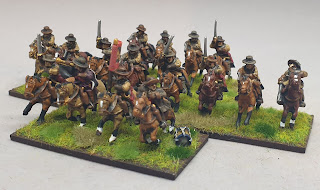
When you think of a 'lifeguard' you think of a group of soldiers whose job it is to protect an individual. So the two King's Lifeguard units are a little bit of a misnomer. The Lifeguard of Foot were effectively just the King's Regiment of Foot, The same can sort of be said about the Lifeguard of Horse.  For actual protecting the King duties you need to look at the Gentlemen Pensioners. The Gentlemen Pensioners still exist as the  Honourable Corps of Gentlemen-at-Arms .  The King's Lifeguard of Horse should not be confused with the Gentlemen Pensioners, they were completely separate units.  The King’s Lifeguard Regiment of Horse, served with the Oxford Army throughout the First Civil War and were led by the King's cousin Lord Bernard Stuart . Raised in Yorkshire in 1642, they were in the thick of the War from the very start being present at the Siege of Hull; Edgehill; the siege of Gloucester; First Newbury; Cropredy Bridge; Lostwithiel; Second  Newbury; the re...

Assault Parties (again)

Image
Way back in the midst of time I posted some converted figures which would be used as assault parties - some harquebusiers on foot (converted from foot officers) and some figures from the storming party pack from PP. At the time of writing I mentioned that I had some unaltered figures from the storming party somewhere. Well they are back, and they are no longer unadulterated. The storming party pack contains 3 petard teams and two grenado throwers. The unadulterated figures from the pack But what is a petard, and what is a grenado? A petard was a small explosive device attached to doors and gateways which hopefully blew the door/gate up thereby allowing the attackers to breach defences. Fun fact: petard comes from the old French word for fart.  Usually carried on a stretcher type device these bombs were propped up against doors, wedged into position and lit. The brave souls who had carried the petard (technically called petardiers) then have to run away very quickly. (There is a pet...

Even More Royalist Commanders

Image
Three more Royalist commanders, these were part of the package of figures that were listed as in absentia for a goodly while. First up Sir Ralph, Lord Hopton . My first use of my new russetted armour paint recipe. I hope that you have noticed that I've tried to give him the correct colour hair (according to his portraits), otherwise all that effort will be for nought. Regular readers (hello both of you) will know that we have already met Sir Ralph here on KeepYourPowderDry before: his story epitomises the notion of 'England tore asunder' as his opponent in battle was invariably his good friend Sir William Waller.  As a 21 year old Hopton undertook the C17th equivalent of a gap year, but instead of travelling to 'find himself' his goal was to 'learn languages'. Finding himself caught up in the Thirty Years War he joined a volunteer English force fighting for Frederick of the Palatinate (whose sons Rupert and Maurice we know quite well). He, and his good frien...

The Marquis of Huntly's Regiment of Foot - The Strathbogie Regiment

Image
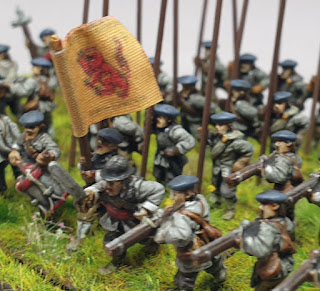
An interesting regiment this one, changing allegiance on a number of occasions, and regularly being disbanded and raised anew.  The Marquis of Huntly appears to be loyal to himself and himself alone: which ever side was furthering his cause (or whoever was fighting against his personal enemies) would benefit from his sword.  Whilst they were Huntly's Regiment they were that in name only - they were trained and commanded in the field by Lieutenant Colonel William Johnston. Raised originally to fight in the First Bishop's War in 1639 they would fight at Trot o’Turriff; the battle of Megray Hill; and Brig o’Dee. Huntly managed to get himself imprisoned in April 1639 attempting to broker a peace deal with the Earl of Montrose; he was released from prison and he and his regiment played no part in the Second Bishops' War. They were raised again in 1644 this time fighting for the King and were present at the taking of Aberdeen; and the storming of Montrose (the town not the Marq...

The Lochaber Highlanders

Image
Here's the final unit of highlanders from the current batch of figures for the Army of Montrose. More will follow, eventually. When I recovered from the psychological trauma of having to paint tartan. The Lochaber Highlanders were a subset of Cameron Highlanders, traditionally fiercely loyal to the crown they are perhaps best known for their modern association with the  Lochaber axe which their valley lends it's name to: the Lochaber axe is a traditional Scottish halberd that may or may not originate from Lochaber. The Lochaber men's loyalty to the Stuarts would be the last acts of the suppression of the Jacobite 1745 Rising. We don't know much about the Lochabermen as an entity in their own right (their exploits with the 1745 Rising are quite well documented) as they were raised by their Clan Chief Allan Cameron of Lochiel and their exploits are possibly subsumed into the general Clan Cameron history.  They are believed to have fought at Tippermuir and Inverlochy, wher...

Captain Thomas Sandford's Company of Firelocks

Image
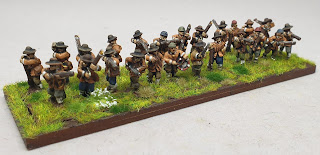
Captain Thomas Sandford (sometimes Sanford) most probably raised his independent Company of Firelocks in Shropshire, for service in Ireland.  Thomas was described as a 'colourful character': which seems fairly accurate, as evidenced by his correspondence. One of his letters, addressed to the garrison at Hawarden, began: "Behold the messenger of death, Sanford and his firelocks, who neither use to give, nor take quarter" He had previously been a quartermaster serving with the Earl of Northumberland's Regiment of Foot during the First Bishops' War.  When originally raised the company had a strength of about 60 men. They arrived in Dublin in 1642 and served under Ormonde, where they helped lead the assault on the Confederate forces at Kilrush. Of the men who went to Ireland 50 men returned to Chester in 1643. Once back in England they fought for the King at Hawarden* and Beeston Castles.  At Beeston legend has it that Sandford and eight of his men famously scaled...

Scots Command

Image
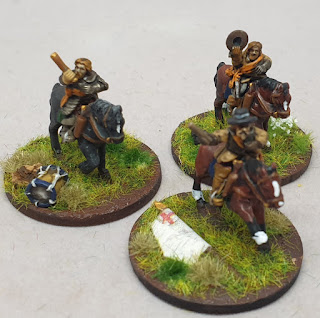
Regular readers (hello both of you) will know that I am always on the lookout for suitable commanders to augment my armies.  This time my attention turned to Naismith whose figures match nicely heightwise with PP. Naismith horses are a little 'esoteric' so they were ditched and replacement PP horses sourced. All these figures come from just two packs - the Montrose character pack (EC14 Montrose, Leslie and Dundee), and the EC06 mounted Scots officer pack. Those tempted to purchase from Naismith should check the status of the company on internet forums, as service can be sporadic at times. As of 03/01/2021 the Naismith-Roundway website has gone, and the domain is available to purchase. I fear that these ranges may now have disappeared. Update April 2021: sadly, it does indeed look like Naismith have disappeared. However a limited stock of Naismith ECW can be found in stock at KeepWargaming (no limbers I'm afraid, as I've just bought the last packs). They do have the per...