Posts

Showing posts from July, 2020

The Duke of York's Regiment of Foot

Image
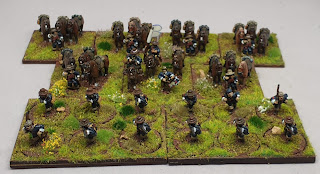
Raised in 1642 for the Irish campaign under the command of  Lord Kerry,  they were actually led by their Lieutenant Colonel, William St Leger. They returned to England in November 1643, joining Vavasour's forces at Gloucester. Possibly participating in a skirmish at Wooton under Edge. After this brief stint in and around Gloucester they joined the King's Oxford Army in 1644, where command was nominally given to the future King James II. Initially quartered at Marlborough, their numbers were swelled with two companies  of troops from Lord Inchiquin's RoF. They possibly helped the defence of Monmouth. They went on to fight at Cropredy Bridge, Lostwithiel, Second Newbury, the Storming of Leicester, before being literally annihilated at Naseby. Peachey and Prince deduced that they wore white coats, although this is by no means certain. They carried red and black gyronny flags. To be very honest, the flag sold them to me. Recently I have started choosing ...
Sir Henry Washington's Regiment of Dragoons

Image
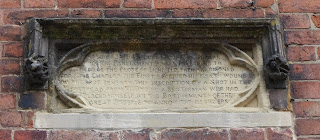
Raised in 1642 by Colonel James Ussher, Washington was Lieutenant Colonel and led the Regiment at Edgehill. He took over command when Ussher was killed, scaling the walls at Lichfield in 1643. They are also known as Prince Maurice's Dragoons as it appears that Maurice was honorary colonel. They fought at  Powick Bridge;  Edgehill; were present at the  Standoff at Turnham Green; stormed  Marlborough; possibly a skirmish  at Burford (where they over wintered as a garrison regiment); the s tandoff at Cirencester; stormed  Cirencester and Birmingham, before taking part in the siege of Lichfield, where Ussher fell. As Washington's Dragoons they fought at C aversham Bridge; C hinnor;  Chalgrove Field;  the s torm of Bristol; the s iege of Gloucester before garrisoning Banbury and Evesham. From there they marched north with Rupert probably firing the only shots fired at the s torm of Stockport; and most probably   Marston Moor -...

The Sieges of Lichfield

Image
At the outbreak of war the Royalists took control of Lichfield, or rather they occupied The Close - the medieval fortified Cathedral precinct surrounded by a moat and defensive walls. Lichfield's population generally sided with the Parliamentarian cause, but the Cathedral staff with the King. The First Siege In March 1643 Lord Brooke led the Parliamentarian assault upon The Close, famously being shot at long range by John Dyott (a deaf mute game keeper, in position on the Cathedral's central spire). This is most probably the first recorded death due to sniper fire. Sir John Gell took over command and The Close fell to Parliament after two days. Brooke's Memorial The Second Siege In April 1643 Prince Rupert led a considerable Royalist force from Oxford to retake the town and Cathedral. Rupert's engineers drained the moat, undermined the walls of The Close and detonated a mine - possibly the first example of a mine being used in England to breach a wall. The Par...

Kent Trained Bands

Image
Kent was a deeply divided county in the Civil War; although nominally under Parliamentary control, there were Royalist risings in Tonbridge and Sevenoaks in 1643, Canterbury in 1647 and a major uprising in 1648, culminating in the Battle of Maidstone. The Trained Bands however remained firmly in Parliamentary control, even in 1648, and formed part of the Southern Association under Sir William Waller. The Bands were organised by "lathes" or areas, a system unique to Kent believed to date to the Kingdom of the Kentish (which existed until the 9th Century). There were five Lathes: Sutton at Hone – adjoining London, including Blackheath, Bromley, Dartford and Westerham Aylesford – from Chatham and Rochester in the north  to Tonbridge in the south, with the county town, Maidstone. Scraye – a more rural area, though including Ashford and Faversham. St Augustines – Canterbury, and the north Kent ports of Dover, Deal and Sandwich Shepway – the south Kent ...

Auxiliary Regiment of the City of Bristol Trained Band

Image
Why has this regiment got a 'Parliamentarian' tag and a 'Royalist' tag I hear you wonder? Originally raised by the good citizens of Brizzle, in 1638 they  consisted of 300 men armed with 210 muskets and 90 corslets; many of these men would venture north to fight in the Bishops Wars the following year. As the country edged closer and closer to Civil War, Bristol was trying to remain resolutely neutral.  When Essex marched on the city the city governance accepted the inevitable and allowed Essex's men to enter Bristol. So the Bristol Trained Bands became 'parliamentarian'. At the outbreak of war the Trained Band was commanded by Colonel Andres Charleton. When Bristol fell to the Royalists the Regiment changed allegiance.  The Trained Band would pretty much remain Bristol's garrison regiment regardless of which faction was in control.   By 1645 there were two regiments of the, now Royalist, Trained Band in the city: they were commanded by Co...

Houses of Interest: Nottinghamshire

Image
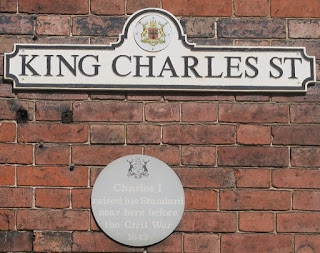
The ECWtravelogue has finally plucked up the courage to cross the border into neighbouring Nottinghamshire.  Nottingham and Nottinghamshire were an integral part of King Charles's corridor of power that stretched from Oxford to York. Having such a strategic position, it is fair to say that the County of Nottinghamshire had a significant part to play in the First Civil War. First let's look at Nottingham : the Royal Standard was raised in August 1642 near Nottingham Castle symbolically signalling the start of the War (even though the fighting had started over a month earlier). Plaque commemorating the raising of the Royal Standard,  corner of Standard Hill/King Charles Street There is another marker, which used to be set into the road at the junction of Standard Hill and King Charles Street. This is now very well worn, but is now sensibly placed on the pavement opposite the plaque on the building. Yet another plaque commemorating the raising of the Royal Standard i...