Continuing my therapeutic blogging (write rather than rant) antidote to incorrect English Civil War coat colour tables for wargamers, I give you the Royalist Regiments of Foot. For all of my coat colour articles see: Introduction Part 1 Parliamentarian coat colours Part 3 Scots coat colours Part 3B Montrose and the Irish Brigade Part 4 Dragoons, Horse and the New Model Army coat colours The Trained Bands London Trained Bands Auxiliary regiments Scarves Same rules apply here, as they did with the Parliamentarian coat colours: Regiments often got renamed when command passed to a new colonel - these regiments are listed under their first name e.g. Jacob Astley's Regiment was originally Richard Fielding's Regiment. Coat colour notes refer to contemporaneous references and some of the deductions made by Reid, Spring, Peachey and Prince. You will also notice that some regiments have several coat colours listed. Where there is some question aro...
After the trauma (!) of researching Turlough MacHenry Ó Néill, I'm giving the Ó Néill s a wide berth for a wee while, and researching a not-Ó Néill regiment. The monumental job of cutting and drilling away cast on pikes that are much too short The Farrells were rulers of Annaly, roughly the modern County Longford. They lost about a quarter of their lands in the plantation of Longford in 1618 but were still in control of the county at the outbreak of the 1641 rebellion. So it comes as no surprise that they joined the rebellion in 1641, setting out their grievances in a letter to Lord Dillon, who presented it to the Dublin government on their behalf: The Papists in the neighbouring counties are severely punished and their miseries might serve as beacons unto us to look unto our own, when our neighbours houses are on fire. They expressed their support for the king and enclosed an oath of loyalty to him. However, they also voiced their disappointment that as Catholics ...
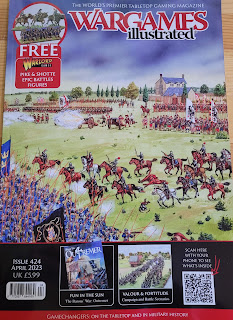
As a follow up to my review of Warlord's Epic P&S foot sprue here's my thoughts on the cavalry sprue that came with the latest (April) edition of Wargames Illustrated. April's WI: the Epic cover art reminds me of the Letraset style action picture scenes of the 1970s First off, let's have a look at the sprue as a whole. An 'interesting' choice of components for a 'cavalry' sprue, but I understand that the commercial need to 'have everything on just one sprue' dictates what is and what isn't on the sprue. I've already seen quite a few people asking which figures are which, on various forums and FB groups. So here is a 'button counter's' view of the sprue. The un-identified figures are generic 'harquebusier type' cavalry. I note that there are two figures that look a bit more officer material than the others, and a cornet who could double up for either the dragoons or the regiments of horse. The major missing elemen...
We all have these 'I could just...' ideas about our toy soldiers which usually involve buying even more shiny things™. There's a couple of *big* thoughts kicking around my head (my RoF really need a third line of musketeers, and surely I need to represent my dragoons mounted too) which get beaten with a metaphorical big stick every time they start making any sort of noise. Recently a new 'I could just...' thought appeared, and before I could find the metaphorical big stick, I had placed two small orders. Jings and crivens*. My armies field three types of artillery - light, medium and heavy (not including frame guns, or the solitary shared siege mortar). Each gun has its own limber. Light guns have a Naismith limber pulled by two horses. Medium and heavy guns have Museum Miniatures limbers and a four horse team. My 'I could just...' thought didn't like medium and heavy guns having the same limber. It argued that heavy guns needed more horses. by Jean Théo...
As I was about to post about the Tower Hamlet's Regiment of the London Trained Bands, and about to go down my usual ranty rabbit hole about coat colours I thought it better to write a general post about Trained Bands. This got out of hand a little and became the coat colours series, without even touching upon the Trained Bands. When I first started my ECW project I took at face value lots of information from what I believed to be 'trusted' sources: it only took a little cursory reading to quickly realise that many of these 'trusted' sources replicate the same errors. Which is why my original Tower Hamlet's Regiment wore red coats and carried the 'wrong' flag. They were quickly given the correct flag, but the red coat issue was slowly nagging me. They have since been rechristened John Birch's, and the Tower Hamlets LTB has been raised anew. This post is a bit more than Coat Colours Part 5 Introduction Part 1 Parliamentarian coat colours Part ...
Finally, here is the first of the long promised size comparison shots. This post looking at foot figures. For the full picture see:- Which Figures? - the original post, where I ruminate about what I want from figures, and what led me to choose Peter Pig. Which Figures? What is Available - the state of play with current 'ECW' 15mm figure ranges; a continually updating look at what figures are available, and what is included/missing from ranges. No commentary on figure size or ruler action (that's down to parts 2a and 3a). Which Figures? Part 2a: Size Matters: Foot - I show side by side comparisons of what is available in 15/18mm, with the obligatory ruler shots. This post. Which Figures? Part 2b: True 15mm/Epic Compatibility: Foot - a more in depth look at smaller 15mm compatibility Which Figures? Part 3a: Size Matters: Horses - I show side by side comparisons of what is available in 15/18mm (obligatory ruler content too) Whi...
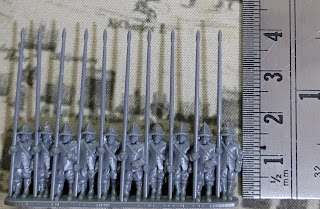
Firstly a big thank you to Warlord Games who sent me a sprue of their new Pike and Shotte Epic Battles infantry. (You can see how I got on with the cavalry sprue here. ) I will try and look at these figures from three different angles: the first impression of someone completely new to the period, the button counter’s standpoint, and then from a seasoned wargamer’s point of view. In all cases I'm looking at these through Wars of the Three Kingdoms spectacles. (Wars of the Three Kingdoms is a more accurate name for the conflicts that were fought in the British Isles in the mid seventeenth century. The English Civil War was just one of these conflicts.) The obligatory next to a ruler picture (the ruler is lined up with the soles of their footwear) The 'new to the period' view This one sprue provides enough figures for one unit (a Regiment of Foot or RoF). Figures look very detailed, moulding is clean and crisp with no flash and only minimal mould lines. The pikes look a bit d...
Regular readers (hello both of you) will realise that my mini-series of battlefield visits is on a bit of a break, due to my battlefield 'hit-list' being not so local anymore. However there were a number of skirmishes and sieges locally. Each of these actions probably doesn't warrant an article by itself, however many of these incidents were related to Rupert's march to York. So I have decided to retrace Rupert's route through Cheshire and Lancashire, adding in any other events/locations as asides. For ease of writing south of the Mersey is 'Cheshire', north of the Mersey is 'Lancashire'. 1644, the Marquis of Newcastle is under siege in York, a last stronghold of Royalist power in the north. The Parliamentarian army of the Eastern Association has been joined by the Scots army of the Solemn League and Covenant. A beleaguered Newcastle has requested help from the King in his stronghold at Oxford. Charles dispatches Prince Rupert north with an army,...
As I have almost run out of Royalists and Parliamentarians to paint, and I have a small Covenanter force it would make sense to create the Army of Montrose. Something I have been shying away from for a very long time due to tartan*, but anything is preferable to painting Napoleonic Austrians. James Graham, the Marquis of Montrose portrait on display at Broughton Castle My Covenanters, and the Scots from the Army of Montrose, could also be combined to form a Scots Royalist Army for the Preston and Worcester campaigns. We know very little about about Montrose's Army; the Scots seem to swap sides and allegiance at the drop of a hat, so much of what we know about Montrose's men dates from a short period of their existence when they fought for the Covenant. Montrose never really had a base for his army, the bigger Scottish towns and cities were firmly with the Solemn League, Montrose drawing soldiers from many much smaller settlements (where diarists and chroniclers, on th...
A jolly to Paris led to a slight painting detour via Napoleon's Rheinbund regiments, but I'm back in seventeenth century England again. What do we know about Tyldesley's Dragoons? In a nutshell - not a lot to be honest. We know that Thomas Tyldesley commissioned William Blundell to captain a company of dragoons. Blundell had got himself into trouble ''inciting riots" in the 1630s so was probably quite suited to a military life. Thomas has the dubious distinction of claiming the first recorded casualty of the First English Civil War. A street fight on 15th July 1642, claimed the life of Levenshulme linen weaver Richard Perceval, when Royalists tried to force the town to hand over its gunpowder stores. Perceval, was allegedly killed by Thomas Tyldesley. Proceedings were begun against Thomas for the killing; however, on 11th August the House of Commons ordered the judges in Lancashire to cease the action. Most likely raised in Lancashire, believed to have d...





Comments
Post a Comment