Sir Alexander Fraser of Philorth's Firelocks
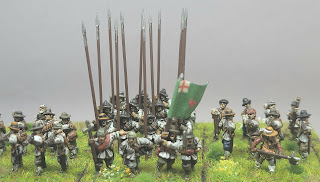
A little reorganisation of the storage boxes vacated some space for my Army of the Solemn League and Covenant. Here's the second of two new units.
A return to painting after a very Scottish-centric focus for most of last year, sees a Covenanter commanded shot unit come to life: Sir Alexander Fraser of Philorth's Firelocks. Philforth's served in the Bishops' Wars and on the Preston campaign in the Second Civil War.
Sir Alexander Fraser was born in 1604, the grandson of Alexander Fraser of Philorth, founder of Fraserborough. Sir Alexander inherited his grandfather's estates in 1624, to the exclusion of his father. He was known as the 'younger of Philorth' until his father died in 1636/7.


By 1644 they were garrisoned in Philorth Castle, before joining Argyll at Dunottar Castle. Believed to have taken part in the battle of Aberdeen, probably as part of Lord Fraser’s Highland Levies.

Fast forward to 1648 Fraser was commissioned as colonel to a new regiment equipped with firelocks. These men were originally intended to be under the command of William Forbes the Master of Forbes. As Forbes declined to serve the Engagement, command passed to Sir Alexander Fraser of Philorth. Furgol suggests that they may have have formed the artillery guard of Hamilton's army.
Muche honored, —The Maister of Forbes haveing quit his employment as ane Colonell in the present levey, and wee being confident of your affection to the publict service, have nominat yow to be Colonel, in place of the Maister of Forbes, and to have that division of the shyre of Aberdein allowed to him. These are therefore to desire yow, vpon receipt heirof, to goe about the leveying of that Regiment quhilk formerlie fell to the Maister of Forbes. Quherin expecting your care
Strength of the new regiment was intended to be 800, but only 150 men would march south to fight in the Preston campaign where many were taken prisoner at Warrington Bridge.

Laird of Phillokth,—I am so confident of your good affection to me, and the aduancement of my affaires, that I doubt not but you wilbe willing to furnish me, for my present occasions, with the summe of two hundred pounds sterling, which I pray you to deliuer either to my selfe, or to the bearer hereof, my seruant, who shall bring you to me; and I shall not only take it as a testimonie of your affection, but shall also repay the same to you, and acknowledge it as an acceptable seruice done to me.
The regiment would be raised anew to support Charles II fighting at Dunbar and marching south to Worcester. At Worcester they would either die on the battlefield or be taken prisoner. Those taken prisoner would be transported to the new world in slavery, only two of their original number ever returning to their Scottish homes.
Family tradition reports that Sir Alexander is said to have been left for dead at Worcester, and was only saved by his faithful servant, who, on finding his master's body, perceived that life still lingered therein, and was fortunate enough to be able to convey him to a place of concealment, where he recovered from his wounds.
After the Wars Sir Alexander spent his remaining years bogged down in numerous litigations surrounding the ownership of various family estates. He would die on the 11th August 1693.

If you enjoyed reading this, or any of the other posts, please consider supporting the blog.



Comments
Post a Comment