Houses of Interest: Highlands & Islands
The final instalment of the ECWtravelogue's summer expedition to Scotland. This time the focus is on the Highlands and Islands.
 |
| Lochaber axes, West Highland Museum, Fort William |
 |
| Mingary Castle seen from the Oban-Castlebay ferry through a very long lens |
C13tth/C14th Mingary Castle was garrisoned by the Covenanters. It fell to the Irish Brigade in 1644. The Castle fell into disrepair and had been abandoned for many years before being renovated in 2013-6. The Castle is now a boutique hotel.
 |
| Inverlochy Memorial |
The second Battle of Inverlochy was fought on the outskirts of modern Fort William. Montrose defeated and almost completely destroyed the forces of Archibald Campbell, 1st Marquess of Argyll, who had been camped near the walls of Old Inverlochy Castle.

A memorial is located on North Road, opposite the car park for Aldi/M&S Foodhall. A stile located near the bus stop (located towards the roundabout) leads to a short, steep path up to the memorial.
Old Inverlochy Castle was abandoned in 1654 in favour of the timber structure Inverlochy Fort, built nearby by Monck's men in the same year which in 1690 was replaced by a stone fort named “Fort William” after King William III. At the time of visiting, the Castle was closed for major stonemasonry repairs.

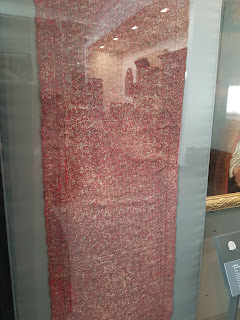
The West Highland Museum in Fort William has several artefacts relating to the battle and Old Inverlochy Castle.
Clach nan Caimbeulach is a Cairn commemorating the Campbells who were pursued from the battlefield and slaughtered by MacDonalds. Alas time was not on my side and I didn't make it up the Old Military road to the cairn
 |
| the restored Kinlochaline Castle |
 |
| Information panel at Boath Doocot |
The Battle of Auldearn, fought on May 9th, 1645, near Nairn, was a significant victory for Montrose.
 |
| the battlefield viewed from Boath Doocot |
Despite being outnumbered, Montrose's forces, including the Irish Brigade and Highland clansmen, decisively defeated the Covenanters led by Major-General Baillie. The battle is considered one of Montrose's greatest victories.
 |
| Auldearn parish church |
Auldearn parish church has a Covenanter memorial attached to the north-west facing inner wall of the old churchyard, although you might have to move some undergrowth to find it.
 |
| in memory of Alexander Drummond of Meedhope, Sir John Murray, and master Gideon Murray, Covenanters who fell at Auldearn |
 |
| The 1645 Inn |
The 1645 Inn is built around a C17th building and gives a nod to the battle with its name. The Inn also serves as a handy navigational aid, as it is believed that many of the battle's dead are buried in the field opposite. Mounds are just about visible to the naked eye.
 |
| fields to the south west of the 1645 Inn are believed to contain a number of burial mounds |
 |
| Boath Doocot |
Boath Doocot is a C17th dovecot. It witnessed the battle and has good views over the battlefield. There is an battlefield interpretation board located at the site.

The Battle of Carbisdale, fought near Culrain, marked the final conflict of James Graham, the 1st Marquis of Montrose, in his efforts to support the Royalist cause. After his defeat at Philiphaugh in 1645, Montrose fled abroad but returned in 1650 as the Captain-General of Charles II's forces. However, the battle ended in a decisive victory for the Covenanter forces, who routed Montrose's troops almost without a shot being fired. An information panel is located on the hillside above the battlefield above Culrain Mains.
 |
| the ruins of Ardvreck castle |
Montrose fled the battlefield and arrived two days later a broken man at Ardvreck Castle where he sought sanctuary with Neil Macleod of Assynt. Numerous accounts have differing trains of events: Macleod's wife betrayed Montrose, Macleod himself betrayed Montrose for a £25000 reward, another has Macleod sympathetic to the Covenanter cause and he arrested Montrose. The upshot of whatever happened was that shortly after Montrose was taken away by the Covenanters, transported to Edinburgh and unceremoniously executed.
 |
| Inverness Citadel, Cromwell's Clock Tower |
All that remains of Inverness Citadel is a rubble clock-tower in an industrial estate on Cromwell Road, north of the city centre. The Citadel was one of several built in Scotland by the invading army of Oliver Cromwell to consolidate their control over the country. The fortress was constructed using stone that came from the ruins of Beauly Priory and Kinloss Abbey, but was demolished following the Restoration in 1660.
 |
| Invergarry Castle |
Invergarry Castle was the seat of the Clan MacDonell of Glengarry, a powerful branch of the Clan Donald. It would be burned down by Monck's men in 1654. The castle would eventually be slighted after Culloden in 1746.
Inveraray Castle was the home of Archibald Campbell, 1st Marquess of Argyll. Argyll was Montrose's nemesis, and also utilised the War as cover to settle a number of clan disputes. The castle would be raided by Montrose in December 1644.
 |
| Inverary Castle |
Inverary would be rebuilt in the C18th, the current incarnation owing a lot to the Victorians who improved the property after a significant fire.
 |
| armoury hall |
The entrance hall, and armoury hall hold a significant number of C17th Lochaber axes and polearms. There's also a couple of English three bar pots in there too.
 |
| Kisimul Castle |
Kisimul Castle, located on an island in Castlebay, Barra gets its name from the Norse ciosamul, meaning "castle island". Kisimul was the stronghold of the MacNeils since the 11th century, and continued to be used by the MacNeils into the C17th for clan disputes. Strangely, for such a small island in the sea, the castle has a freshwater well. The castle is currently being renovated by Historic Environment Scotland, so is closed to visitors at the moment.
 |
| the Lewis battlefield cairn |
The Battle of Lewis was a clan dispute that led to all out war at Barvas on the Isle of Lewis. It was the last clan battle fought on Lewis in 1654 between the Morrisons of Ness and the Macauleys of Uig.
Stornoway Castle, was a similar island castle to Kisimul. It was garrisoned by Royalists but was taken by Parliament in 1653 by detachments from Colonel Thomas Cooper’s and Colonel Ralph Cobbett’s Regiments of Foot, who destroyed the castle with gunpowder in 1654
The ruins of the original Stornoway Castle are now found underneath Pier 1 at Stornoway ferry terminal.
A short-lived Commonwealth Fort was built in the vicinity of the Port Authority's building on the modern harbour, traces turning up in an archaeological survey undertaken when the building was extended in 2019.
 |
| St Clement's Church |
The late C15th St Clements's Church on the Isle of Harris is the last resting place of Sir Norman Macleod of Berneray. Sir Norman fought for the King at Worcester where he was captured and later imprisoned in the Tower of London. He escaped and returned to Berneray in 1653, leading the defence of Stornoway Castle later in the same year. he was knighted for loyalty and valour by Charles II.
 |
 |
| Macleod's Gunnery |
Sir Norman was born at Macleod’s Gunnery on Berneray, the oldest surviving building on Berneray, dating back to the 16th Century. A marble slab above the Gunnery commemorates his birthplace.
Postcodes for SatNavs
St Clement's Church, Rodel, A859, Isle of Harris HS5 3TW




Excellent field work. I'll be making use of this at some point in the future. I did visit Inverlochy a while back. I don't know what I was expecting but I came away somewhat disappointed. I did not think to check if the Fort William museum held anything.
ReplyDelete